- All
- Product Name
- Product Keyword
- Product Model
- Product Summary
- Product Description
- Multi Field Search

Views: 0 Author: Site Editor Publish Time: 2026-07-07 Origin: Site
Selecting the correct ferroalloy actively drives operational success in modern metallurgy. A slight deviation in alloy quality significantly impacts your final steel integrity. Procurement teams constantly battle volatile markets alongside highly inconsistent material specifications. These challenges often trigger poor recovery rates, unexpected processing expenses, and completely rejected steel batches. Relying purely on basic pricing metrics ignores the massive downstream effects of subpar alloys. This guide offers an objective framework designed for both metallurgists and procurement professionals. We will explore how you can accurately evaluate different grades. You will also learn to navigate complex technical specifications and audit potential suppliers effectively. By applying these exact strategies, you can secure high-yield materials, protect your operational margins, and consistently meet strict metallurgical standards.
Matching the specific FeSi grade (e.g., 75%, 72%, or high-purity) to the end-product requirements prevents overspending on unnecessary purity or losing yield to excess impurities.
Physical properties—specifically particle size distribution and fines content—are just as critical as chemical composition for maximizing recovery rates.
Evaluating a ferrosilicon manufacturer requires auditing their quality control protocols for trace element management (Al, Ca, Ti) and packaging stability.
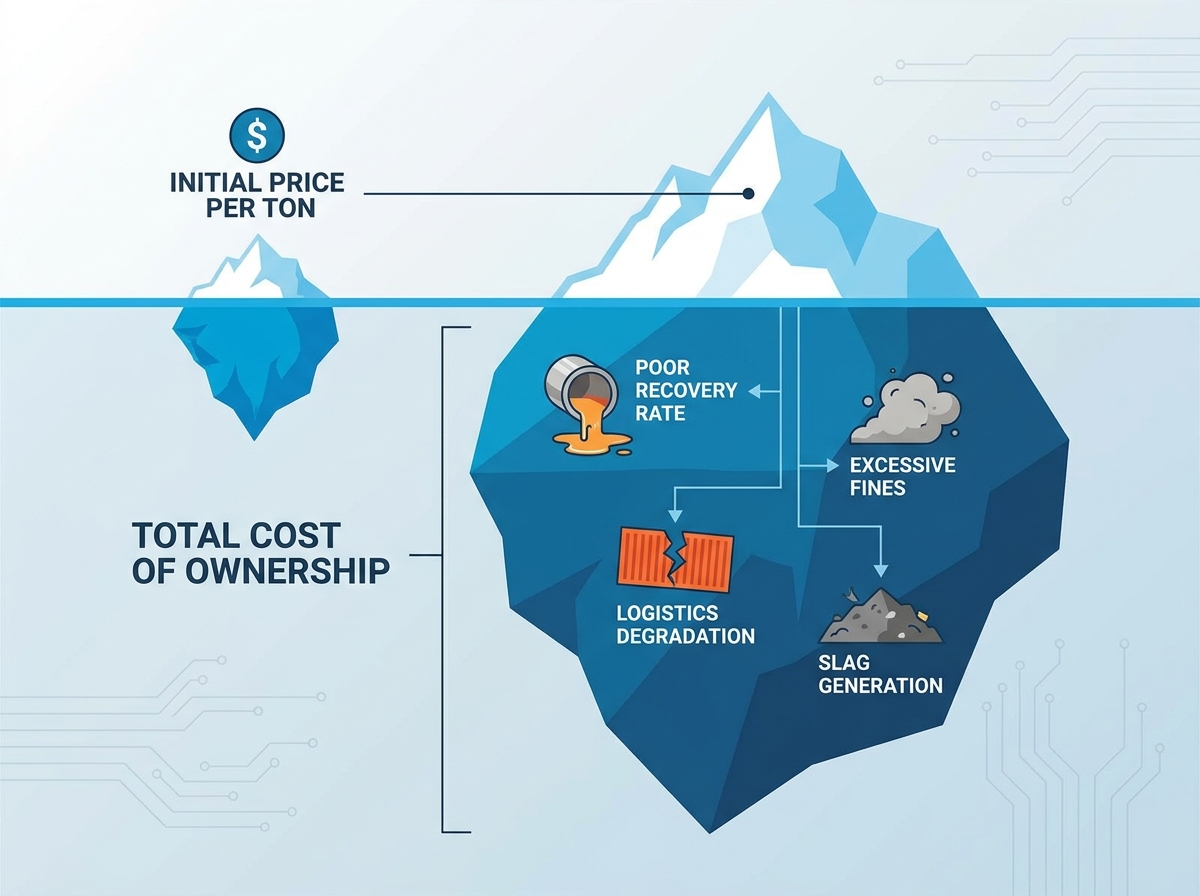
Total Cost of Ownership (TCO) extends beyond the initial price per ton, factoring in dissolution efficiency, transport degradation, and slag generation.
Inefficient deoxidation leaves dangerous levels of dissolved oxygen inside the molten metal. When this liquid steel solidifies, the trapped oxygen forms microscopic gas pockets. We refer to this common defect as porosity. Porosity drastically compromises the structural integrity of the metal. It severely lowers tensile strength and creates brittle zones. Ultimately, this defect causes your batch rejection rates to soar. You must deploy a reliable steelmaking deoxidizer to bind this stray oxygen quickly. The silicon reacts to form silica. This silica then floats harmlessly into the slag layer. This critical reaction leaves clean, high-quality steel behind.
Silicon does much more than simply remove oxygen. It acts as a highly effective alloying element. Precise silicon additions fundamentally improve overall steel hardenability. They consistently boost yield strength across various structural grades. Electrical steels rely entirely on exact silicon levels to enhance magnetic permeability. Spring steels require it to maintain their high elastic limits. When you source a highly efficient alloy, your furnace operators hit their chemical targets on the first attempt. This precision reduces tap-to-tap times and maximizes daily throughput.
Choosing sub-optimal grades introduces severe hidden penalties. High impurity levels generate excessive slag volumes inside the furnace. Extra slag requires significantly more electrical energy to maintain melting temperatures. It also causes rapid, aggressive wear on your refractory linings. Degraded refractory bricks force premature furnace shutdowns and expensive relining projects. Furthermore, off-spec additions force operators to perform secondary corrective treatments. These unplanned processing steps consume valuable time and destroy your profit margins.
You will frequently encounter two primary options when sourcing industrial grade ferrosilicon for bulk operations. FeSi 75% contains roughly 75 percent silicon. FeSi 72% contains slightly less. FeSi 75% remains the undisputed global standard for general carbon steel deoxidation. It provides excellent, predictable silicon recovery during ladle treatments. FeSi 72% works exceptionally well for specific heavy structural steel alloying. It often presents a more economical option for mills producing rebar or low-tier commercial steels. You must analyze your specific furnace recovery rates before switching between these two standards.
Highly sensitive applications demand high-purity variants. Tire cord, bearing steel, and spring steel simply cannot tolerate harmful inclusions. Trace amounts of aluminum or calcium react to form hard oxide stringers. These microscopic stringers cause catastrophic fatigue failures during service. They also cause wire breaks during the drawing process. You must specify strictly low-aluminum and low-calcium grades for these critical heats. High-purity alloys undergo extensive secondary refining at the production facility. This extra step guarantees absolute minimal inclusion formation in your final product.
Electrical steel production requires incredibly strict carbon control. Stainless steel manufacturing also demands minimal carbon pickup during late-stage alloying. A dedicated low carbon FeSi alloy specifically solves this precise problem. Standard industrial grades often contain too much residual carbon from the smelting coke. Low-carbon variants undergo specialized processing to eliminate these carbon traces. By using them, you prevent unwanted carbide precipitation along the grain boundaries. They ensure optimal magnetic performance and maximum anti-corrosive properties.
Grade Category | Silicon Content | Key Limitation | Primary Application |
|---|---|---|---|
Standard FeSi 75% | 74% - 76% | Standard Al/Ca limits | General carbon steel deoxidation |
Standard FeSi 72% | 72% - 74% | Standard Al/Ca limits | Heavy structural steel alloying |
High-Purity FeSi | >75% | Ultra-low Al and Ca | Tire cord, bearing, and spring steel |
Low-Carbon FeSi | >75% | Strictly minimized Carbon | Electrical and stainless steel |
Modern steel mills rely heavily on automated alloy addition models. These software models calculate precise alloy weights based on expected silicon content. Lot-to-lot variance completely disrupts this delicate automation. If one batch contains 76 percent silicon and the next drops to 71 percent, your chemistry entirely misses the target. You must establish extremely tight tolerance ranges. Consistent chemistry prevents costly downgrades. It guarantees your automated systems operate smoothly without requiring constant manual overrides.
Elevated aluminum, calcium, and titanium pose severe metallurgical risks. Titanium reacts vigorously to form hard carbonitrides. These abrasive particles ruin expensive machining tools during downstream processing. Aluminum forms stubborn alumina clusters. These clusters clog continuous casting nozzles. You must proactively define strict upper limits in all procurement contracts. Treat these trace elements as critical fail points. Routine auditing of impurity levels protects your continuous casting operations from disastrous interruptions.
Granularity directly dictates melt penetration and reaction speed. Optimal sizing usually falls squarely between 10-50mm or 50-100mm. Proper sizing allows the solid lump to pierce the thick slag layer. It then dissolves efficiently inside the liquid steel bath. Oversized lumps simply float. They oxidize uselessly in the open air, causing massive alloy loss. Furthermore, large lumps absorb too much heat. They create localized cold spots within the ladle.
Excessive fines create even worse problems. Dust cannot penetrate the slag layer at all. It simply ignites and burns off on the turbulent surface. This lowers your recovery rates significantly. Fines also present major environmental hazards. They create explosive dust clouds and severe inhalation risks for your operators.
You must rigorously assess the crushing strength of the material. High-density lumps survive rough maritime transit and aggressive mechanical handling. Weak, porous materials break down rapidly into useless dust. You pay for solid lumps, but you often receive bags filled with degraded powder. Evaluating the physical integrity upfront ensures the alloy arrives at your furnace exactly as specified.
Demand statistically significant sampling from every delivered batch.
Screen for undersized fines using strict 3mm or 5mm mesh limits.
Verify crushing strength limits against established baseline benchmarks.
Cross-reference the measured bulk density against the supplier claims.
Calibrate your automated weighing hoppers to match the specific lot density.
Particle Size | Slag Penetration | Dissolution Rate | Expected Yield |
|---|---|---|---|
> 100mm (Oversized) | Poor (Floats) | Too slow | Low to Moderate |
10mm - 50mm (Optimal) | Excellent | Rapid and uniform | Very High |
< 3mm (Fines/Dust) | None (Burns on surface) | Instantaneous (Lost) | Extremely Low |
Finding a trustworthy ferrosilicon manufacturer steelmaking partner requires rigorous physical auditing. Look specifically for modern submerged arc furnace (SAF) capacity. High-capacity furnaces inherently maintain better thermal stability during smelting. They produce far more consistent chemistries than older, smaller units. Automated crushing and screening lines represent absolute mandatory requirements. Manual crushing generates unpredictable lump sizes. It also produces excessive dust. Advanced optical sorting technology further proves a supplier takes sizing seriously.
Pre-shipment spectrometric analysis guarantees specification compliance. X-ray fluorescence (XRF) and optical emission spectrometers (OES) provide rapid, highly accurate elemental breakdowns. Relying on outdated wet chemistry delays shipments and increases error margins. You must also demand third-party ISO certification verifications. ISO 9001 proves they actually maintain standardized operating procedures. It shows they actively track and correct internal non-conformities before shipping materials.
Avoid suppliers handing out generic, generalized grade sheets. You need accurate, heat-specific Certificates of Analysis (CoA). True traceability connects every single jumbo bag back to a specific furnace tap. If a defect occurs during your casting process, you must isolate the exact alloy batch responsible. Rigorous documentation practices separate premium manufacturers from unreliable commodity brokers.
Evaluate their internal inventory buffer capacity. Long shipping lead times routinely disrupt tightly scheduled mill operations. A strong supplier holds adequate safety stock. Furthermore, strictly enforce anti-moisture packaging protocols. Double-layered ton bags featuring thick polyethylene inner liners protect the alloy from extreme humidity and ocean spray. Weak packaging rips during transit. It allows moisture to destroy the material long before it reaches your warehouse.
Finding the optimal ferrosilicon grade requires balancing basic metallurgical necessity against particle consistency and long-term supplier reliability. When you focus solely on the lowest initial quote, you expose your entire melting operation to massive hidden risks. Substandard alloys drive up processing times, destroy refractory linings, and increase rejection rates. You must adopt rigorous, yield-based evaluation models to protect your true margins. Moving forward, take proactive steps to validate your supply chain.
Request a comprehensive specification sheet detailing all trace element maximums.
Order a small pilot sample strictly for real-world recovery and dissolution testing.
Schedule a physical facility audit with your shortlisted suppliers to verify their crushing lines.
Update your procurement contracts to penalize excessive fines and moisture content.
A: Foundries use a highly specialized casting inoculant alloy to actively control graphite formation during iron solidification. These unique inoculants contain precise, intentional additions of active elements like barium, strontium, or zirconium. Standard steelmaking deoxidizers completely lack these specialized active elements. They solely focus on removing stray oxygen and adding base silicon to the melt.
A: Undersized pieces act exactly like dust. They ignite and burn off at the top slag layer before ever reaching the molten steel. This violently lowers your overall efficiency. Conversely, oversized pieces take far too long to dissolve properly. They disrupt tight furnace timing and create localized cold spots. Optimal sizing ensures deep melt penetration and maximum silicon recovery.
A: Production relies entirely on highly energy-intensive submerged arc furnaces. Smelting raw quartz and metallurgical coke requires massive amounts of continuous electrical power. Consequently, legitimate global pricing ties directly to regional electricity tariffs. Any sudden fluctuation in local power costs immediately shifts the baseline production expense for manufacturers.
A: You must store it exclusively in a dry, well-ventilated indoor warehouse. Moisture exposure causes rapid, severe physical degradation. The alloy absorbs water and physically breaks down into useless dust. Furthermore, damp ferrosilicon reacts chemically to emit highly toxic and extremely flammable gases like phosphine. Proper storage guarantees safety and preserves total material integrity.

 English