- All
- Product Name
- Product Keyword
- Product Model
- Product Summary
- Product Description
- Multi Field Search

Views: 0 Author: Site Editor Publish Time: 2026-07-06 Origin: Site
Selecting the wrong abrasive medium carries severe operational risks. Modern manufacturing facilities often face increased cycle times and severe surface contamination. Premature grain breakdown and excessive abrasive consumption also plague poorly planned operations. These ongoing failures disrupt production schedules and heavily inflate operational budgets.
Technical buyers, procurement managers, and process engineers need a reliable framework. They must evaluate their media options using evidence-based criteria. You need to understand how physical properties and application requirements dictate the right choice. This guide breaks down the essential performance characteristics of Brown Fused Alumina (BFA) and White Fused Alumina (WFA).
We explore chemical compositions, hardness profiles, and specific industrial applications. You will learn exactly how to align your abrasive selection with your precise surface finishing requirements. The right abrasive ensures optimal performance and protects your critical components.
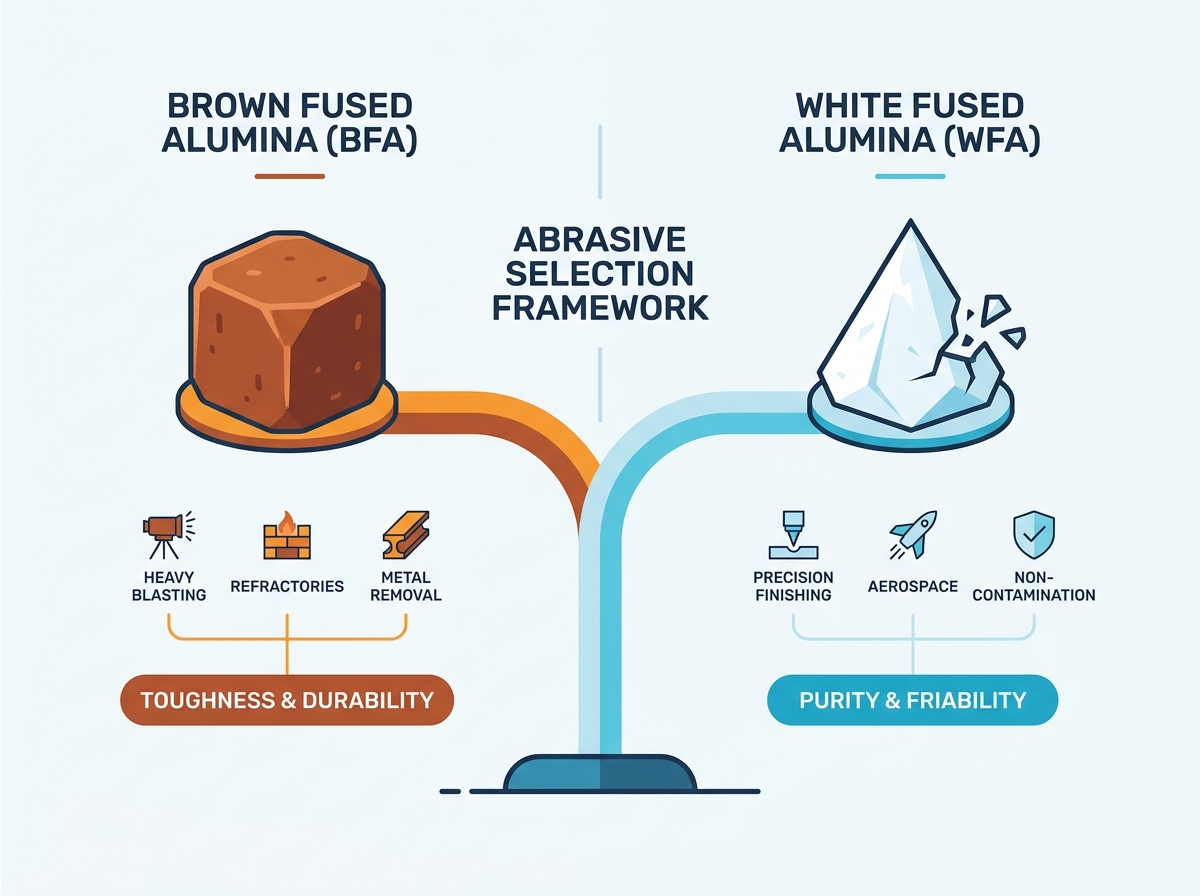
Purity vs. Toughness: WFA offers higher purity (99%+ Al₂O₃) and high friability for cool, precision cutting; BFA offers superior toughness and durability for aggressive material removal.
Application split: BFA is the standard for heavy-duty blasting and refractories; WFA is required where iron contamination is strictly prohibited (e.g., aerospace, medical devices).
Cost Efficiency: BFA generally provides a lower initial cost and higher reusability rate, making it more cost-effective for high-volume, non-critical surface preparations.
Supplier Cruciality: Sourcing consistency (particle size distribution and chemical stability) is as important as the material type itself when qualifying a production partner.
Understanding fundamental abrasive properties builds technical expertise. We must contrast the underlying characteristics driving material performance. Abrasive grains behave differently under intense mechanical stress. You can predict their behavior by analyzing their specific chemical makeup.
Aluminum oxide (Al₂O₃) forms the core of both materials. However, their specific production methods yield distinct chemical profiles. Manufacturers produce BFA by smelting calcined bauxite in an electric arc furnace. This process yields an Al₂O₃ content typically ranging between 95% and 97%. The remaining percentage contains essential trace elements. Manufacturers create WFA by smelting high-purity calcined alumina. This intensive process achieves an Al₂O₃ content exceeding 99%.
Titanium dioxide (TiO₂) plays a crucial role in BFA. BFA typically contains 1.5% to 3% TiO₂. This specific addition fundamentally alters the crystalline structure. It grants the material its characteristic dark color. More importantly, titanium dioxide gives the grain exceptional toughness. High purity makes WFA highly brittle. BFA absorbs heavy impacts without instantly shattering.
Hardness measures penetration resistance. Friability measures how easily a grain fractures under impact. You must evaluate both metrics simultaneously. WFA ranks slightly higher on the Mohs and Knoop hardness scales. It boasts a Knoop hardness of approximately 2200 kg/mm². BFA registers closer to 2000 kg/mm². Both materials cut aggressive anchor profiles into hard metal substrates.
WFA exhibits extreme friability. The grains shatter upon impact during blasting. This shattering action continuously exposes new, razor-sharp cutting edges. This ensures a cool, fast cut on sensitive substrates. Conversely, blocky grains define high-hardness brown fused alumina grit. This durable alternative strongly resists micro-fracturing. It maximizes your recycling cycles in closed-loop blast cabinets.
Thermal stability dictates performance in high-temperature applications. Both minerals boast exceptionally high melting points. BFA melts at approximately 2050°C. WFA pushes this threshold slightly higher, melting near 2250°C. WFA offers slightly better thermal conductivity. This helps dissipate heat during precision grinding operations.
Property Matrix | Brown Fused Alumina (BFA) | White Fused Alumina (WFA) |
|---|---|---|
Al₂O₃ Content | 95% - 97% | 99%+ |
TiO₂ Content | 1.5% - 3.0% | < 0.1% |
Toughness Level | Very High (Impact Resistant) | Low (Highly Friable) |
Primary Grain Shape | Blocky and robust | Sharp and angular |
Color | Brown / Dark Amber | Pure White |
Engineers must build a decision-making framework based on specific industry use cases. Matching the abrasive grain to your exact application prevents catastrophic part failures. It also optimizes your overall operational workflow. Let us explore the specialized domains for each material.
BFA serves as the undisputed workhorse for heavy industries. You should specify this material for aggressive surface profiling. It rapidly removes heavy rust, thick mill scale, and old industrial coatings. Facilities heavily rely on it for general deburring operations. Its tough nature prevents excessive dust generation during heavy blasting.
Foundries depend on this mineral daily. It operates as an indispensable metallurgy industry abrasive. Steel plants use it for continuous slag conditioning. Abrasive manufacturers bond it into heavy-duty grinding wheels. These wheels rapidly remove metal from cast iron components.
High thermal stability makes it invaluable for high-temperature containment. Engineers specify it as a premium refractory grade corundum grit. Plants use it to construct massive furnace linings. Manufacturers press it into high-density kiln furniture. The material maintains its structural integrity under extreme thermal cycling.
Best Practices for BFA Applications:
Use pressure blast systems to maximize the impact force of blocky grains.
Install magnetic separators in recycling loops to remove abraded metal.
Maintain adequate dust extraction to clear pulverized fines from the cabinet.
WFA dominates highly controlled, strict-compliance environments. You must specify it for applications requiring strict adherence to non-ferrous standards. Aerospace components cannot tolerate trace iron contamination. Medical device manufacturing strictly prohibits surface impurities. Trace iron causes catastrophic localized galvanic corrosion. WFA prevents this risk entirely.
Technicians use micro-graded WFA for precision lapping. They use it to polish optical lenses and silicon wafers. It provides the ideal surface preparation for specialized non-stick coatings. Teflon and advanced aerospace alloys require its pure, sharp profile for mechanical adhesion.
Foundries also require pristine materials for specialized molds. WFA serves as an essential precision casting grit. Operators use it during investment casting shell building. It acts as the primary stucco layer. The exceptional chemical purity prevents adverse reactions. It will not react with the molten super-alloys poured into the ceramic shell.
Selecting the correct material type only solves half the problem. You must address implementation realities by choosing the precise grain size. Scale and geometry dictate your sizing strategy. Proper size selection directly influences cycle times and surface finishes.
Abrasive sizing drastically impacts your target anchor profile. Macrogrits generally range from F12 to F220. These larger particles carry immense kinetic energy. They strike the surface forcefully to generate deep, rough anchor profiles. You use macrogrits for fast, aggressive material removal.
Microgrits range from F230 down to F1200. These microscopic particles remove material very slowly. They generate shallow, highly uniform surface finishes. You apply microgrits for final polishing and precise dimensional lapping. Choosing the wrong category destroys delicate part tolerances.
You must select grits graded to strict international industry standards. The Federation of European Producers of Abrasives (FEPA) dictates precise sizing tolerances. ANSI and JIS provide similar rigorous grading frameworks. Compliance prevents disastrous surface defects.
Poorly graded materials contain "rogue boulders." These oversized grains slip through low-quality sizing screens. A single oversized grain causes deep, uncorrectable surface scratches. These scratches ruin expensive machined components. Always demand strict adherence to recognized grading charts.
You must understand the distinct wear rates of each material. A specific grit size in WFA breaks down much faster. It fragments into finer dust quicker than the equivalent size in BFA. This rapid breakdown directly impacts your automated blasting parameters.
You must constantly replenish WFA in automated systems. The high friability dramatically increases the load on your dust collection systems. BFA maintains its original grit size much longer. It requires less frequent top-offs. BFA generates significantly less airborne dust per operating hour.
Common Mistake: Operating blast nozzles at excessive pressures. Pushing WFA above 60 PSI causes instantaneous grain pulverization. This wastes the abrasive without improving cutting speeds.
Standard Size Range | Typical Designations | Primary Function |
|---|---|---|
Coarse Macrogrits | F12 - F36 | Heavy scale removal, deep profiling |
Medium Macrogrits | F40 - F80 | General deburring, paint prep |
Fine Macrogrits | F90 - F220 | Light cleaning, coating adhesion prep |
Microgrits | F230 - F1200 | Precision lapping, fine polishing |
You must drive your shortlisting logic using strict evaluation criteria. Risk mitigation is paramount when selecting industrial partners. Inconsistent raw materials paralyze production lines. You need a structured approach to audit potential manufacturing partners.
A reliable brown fused alumina grit supplier must guarantee absolute batch consistency. They must provide precise Particle Size Distribution (PSD) data. Proper PSD ensures the abrasive performs predictably during every shift. Suppliers verify this using rigorous Ro-Tap sieve analysis.
You must demand transparent Certificates of Analysis (COA) for every shipment. The COA validates the chemical makeup. It confirms the critical alumina and titanium dioxide percentages. Never accept deliveries lacking proper chemical and physical documentation.
You must evaluate suppliers based on their specific crushing equipment. The mechanical crushing method dictates the final grain shape. Different tooling requires very specific particle geometries. Barmac crushers use high-velocity impact forces. This method produces highly desirable, blocky grains.
Roller crushers use heavy compression forces. Ball mills tumble the material repeatedly. These alternative methods often produce sharper, sliver-like grains. Blocky grains survive longer in blast cabinets. Sharp grains cut faster in bonded wheels. Your supplier must control these shaping processes accurately.
You must assess the durability of the supplier's packaging solutions. Industrial abrasives absorb ambient moisture easily. Moisture ruins flowability in automated abrasive metering valves. Suppliers must utilize heavy-duty, moisture-resistant 1-ton bulk bags. They should include inner plastic liners.
Capacity Audits: Verify the supplier's ability to handle sudden demand surges.
Inventory Buffers: Ensure they maintain adequate domestic safety stock.
Logistics Tracking: Confirm their ability to provide accurate shipping schedules.
They must rapidly scale production without ever compromising their internal grading accuracy.
Modern procurement demands strict operational compliance. Look for verifiable ISO 9001 certifications. This ensures the facility operates under a formalized quality management system. Environmental compliance is equally critical.
Smelting bauxite consumes massive amounts of electricity. It also generates significant industrial dust. Audit the supplier's dust mitigation technology. Ensure their electric arc furnaces meet local environmental emissions standards. Sustainable partners protect your supply chain from sudden regulatory shutdowns.
Selecting the optimal abrasive requires a precise understanding of material science and application demands. You must balance the physical toughness of BFA against the extreme purity of WFA. BFA remains the robust, highly durable workhorse for heavy industry. It dominates aggressive surface preparation and high-temperature refractory applications.
WFA stands as the pure, friable specialist. You must specify it for precision cutting and strict non-contamination environments. It safely processes aerospace alloys and delicate medical devices. Choosing correctly prevents ruined components and excessive dust generation.
Take immediate action to validate these parameters in your facility. We strongly encourage buyers to request small-batch samples. Conduct rigorous in-house testing immediately. Verify the exact grit distribution and measure the material breakdown rates. Run these controlled tests before you commit to large annual tonnage contracts.
A: Yes, but this practice remains quite rare. Some manufacturers blend them to create custom abrasive grinding wheels. The blend balances extended tool life with a highly aggressive cut rate. However, we never recommend blending loose grains for standard blast cabinets. Mixed grains break down at completely different rates, ruining your media consistency.
A: Black Fused Alumina acts as an economical alternative. It contains significantly lower Al₂O₃ levels and much higher impurities. Industries primarily use it for basic, non-critical polishing operations. It also serves excellently in anti-slip resin flooring applications. It is notably cheaper than both BFA and WFA.
A: Yes, it carries a distinct risk. BFA contains trace amounts of iron and titanium from the bauxite ore. These trace metals easily embed into soft substrates. You must use high-purity WFA or glass beads to process passivation-critical stainless steel components safely.

 English