- All
- Product Name
- Product Keyword
- Product Model
- Product Summary
- Product Description
- Multi Field Search

Views: 0 Author: Site Editor Publish Time: 2026-07-03 Origin: Site
Industrial grinding demands exactness. Inconsistent abrasive raw materials routinely lead to wheel degradation, surface burns, and alarming rejection rates. Precision relies heavily on the abrasive medium you select.
The current market overflows with trading companies and generic abrasive suppliers. This saturation makes it incredibly difficult to verify true manufacturing capabilities, batch-to-batch consistency, and core material purity. You risk compromising your entire production line if you partner with the wrong supplier.
We will provide procurement and engineering teams a solid, risk-mitigating framework. You will learn how to evaluate technical capabilities, verify smelting processes, and confidently shortlist a reliable partner. This guide ensures your high-precision grinding applications achieve maximum efficiency and repeatable success.
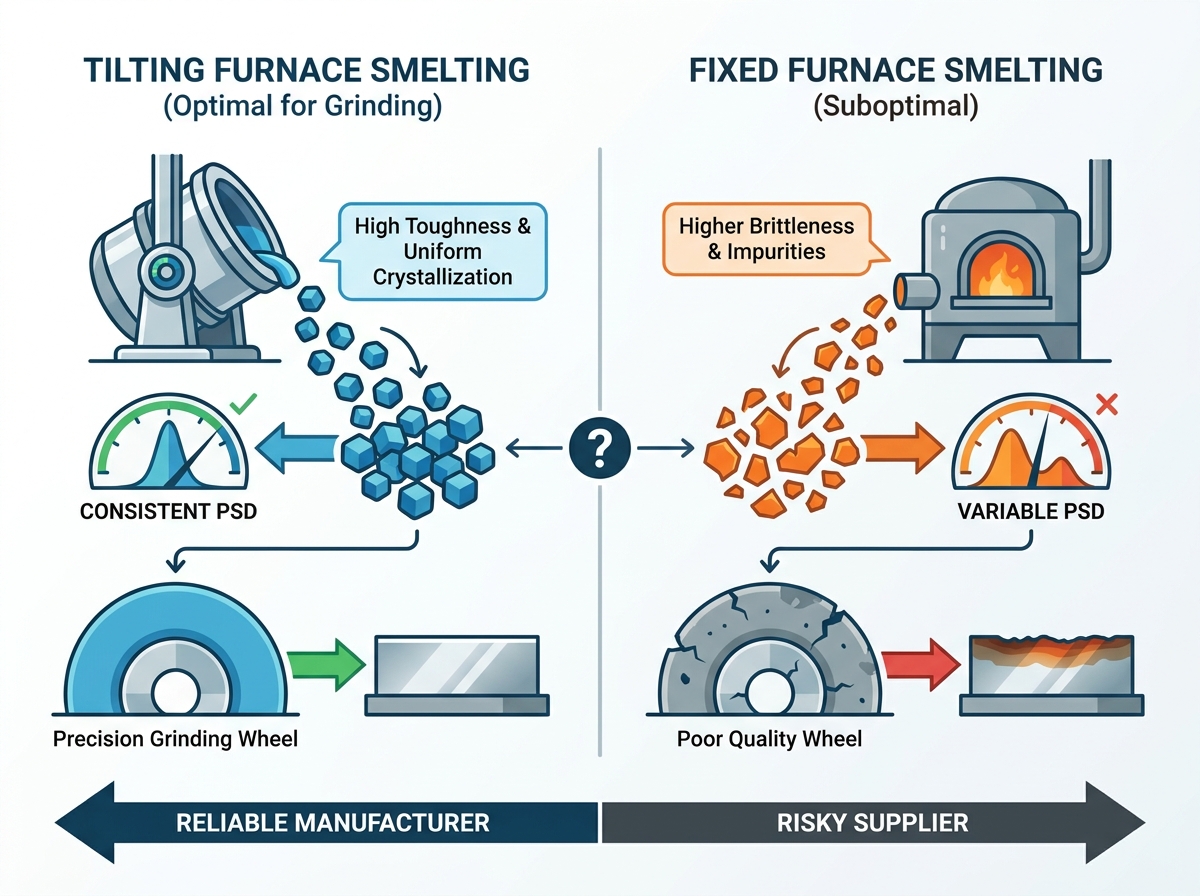
Furnace Technology Matters: Tilting furnace smelting produces higher toughness grains ideal for grinding, compared to cheaper fixed-furnace alternatives.
Prioritize PSD Consistency: A qualified manufacturer must provide transparent Particle Size Distribution (PSD) reports adhering strictly to FEPA, ANSI, or JIS standards.
Chemical Purity is Non-Negotiable: High-purity brown fused alumina powder requires precise Al2O3 (typically 95%+) and controlled TiO2 levels to ensure optimal friability and self-sharpening properties.
Audit for Direct Manufacturing: Distinguish between primary producers and third-party distributors to guarantee supply chain stability and technical customization.
Grinding operations operate under extreme stress and tight tolerances. You cannot afford variability in your raw materials. Choosing the right abrasive source dictates the success of your bonded grinding tools.
Substandard abrasives inflict heavy financial losses on manufacturing facilities. Off-spec industrial abrasive powder causes uneven wheel wear. This inconsistency forces operators to dress grinding wheels more frequently. Frequent dressing wastes valuable abrasive material and drastically reduces tool life.
Poor quality grains also generate excessive heat during operations. This thermal buildup leads to severe surface finishes and metallurgical damage. Parts suffer from surface burns. The resulting scrap rates consume your profit margins. Unexpected production downtime becomes a daily operational hazard. Every hour your line stops, you lose money.
Grinding applications require strictly controlled grain shapes and specific toughness profiles. Vitrified wheels need abrasive grains that hold their structure under pressure. Resin-bonded wheels require hydrophilic surfaces for strong resin adhesion.
These requirements differ vastly from generic surface preparation media. Standard sandblasting media powder generally utilizes cheaper crushing methods. Sandblasting media tolerates wider particle size variances. It lacks the tight tolerances necessary for precision wheel formulation. Do not interchange these materials. Grinding demands specialized engineering.
You must establish strict criteria before selecting a partner. The ultimate goal is achieving zero-defect production runs. Your supplier must deliver highly repeatable batches at a massive scale. Consistency across tons of material ensures your grinding wheels perform identically every time. You need a partner, not just a vendor.
Technical transparency separates genuine manufacturers from basic traders. You must investigate the chemical composition and the specific smelting technology utilized. These factors define the performance limits of the abrasive.
Chemical purity dictates how the abrasive behaves under friction. You must require a baseline of 95% or higher Al2O3. This high alumina content defines genuine high-purity brown fused alumina powder. It provides the core hardness required to cut metal efficiently.
Next, assess the Titanium Dioxide (TiO2) content. TiO2 acts as a crucial modifier. It directly dictates the toughness of the grain. Optimal TiO2 levels (typically between 1.5% and 3.8%) allow the grain to micro-fracture continuously. This controlled friability creates new, sharp cutting edges. Proper TiO2 levels also facilitate the characteristic blue-firing process. Blue-firing increases grain toughness for heavy-duty applications.
How the bauxite is melted is just as important as what goes into the furnace. The smelting method is the ultimate expert litmus test for any supplier.
Tilting Furnace: This method involves pouring the molten alumina out of a tilting crucible. It yields high toughness and highly uniform crystallization. The pouring process leaves heavier impurities behind. Tilting furnace BFA is absolutely essential for heavy-duty grinding wheels.
Fixed Furnace: The molten mass cools entirely inside the fixed furnace shell. This creates varying cooling rates across the block. The resulting grain exhibits higher brittleness. It costs less to produce. This method is often suitable for refractory grade aluminum oxide. It is suboptimal for premium grinding wheels.
Smelting Technology Impact Matrix
Process Factor | Tilting Furnace Method | Fixed Furnace Method |
|---|---|---|
Cooling Mechanism | Poured into molds, rapid cooling | Cooled slowly in the furnace shell |
Crystallization | Highly uniform small crystals | Variable crystal sizes |
Toughness Level | Very High (Ideal for Grinding) | Moderate to Low (High Brittleness) |
Impurity Management | Excellent (Slag is easily separated) | Poor (Impurities trapped in the core) |
Even the purest alumina fails if its size and shape are incorrect. Quality control protocols during crushing and grading are critical. They determine how the grain packs into a grinding wheel.
You cannot accept proprietary grading systems. Verify the supplier’s strict compliance with recognized international standards. Ask for FEPA compliance for the European market. Request ANSI standards for North America. Look for JIS standards if targeting Japan. A rigorous manufacturer provides explicit PSD curves proving they hit the exact micron tolerances required.
Producing coarse macrogrits (F12 to F220) differs from milling microgrits (F230 and finer). Ensure the supplier utilizes dedicated milling lines. They must possess professional water-washing facilities. Water-washing removes ultrafine dust adhering to the grains. It prevents cross-contamination between different grit sizes. Dust contamination ruins the porosity of bonded wheels. It causes dangerous wheel glazing during operation.
The crushing method dictates the physical geometry of the abrasive. Assess their mechanical crushing capabilities carefully.
Barmac crushers, or Vertical Shaft Impactors (VSI), hurl grains against each other. This produces a blocky, isometric grain shape. Blocky grains possess high bulk density. They are highly structurally sound. Blocky grains are absolutely critical for manufacturing strong bonded grinding wheels.
Conversely, roller crushing produces sharp, needle-like splinters. These sharp edges cut aggressively but break down rapidly. They are better suited for coated abrasives like sandpaper, not dense grinding wheels.
Common Mistakes in Sourcing: Ignoring the crushing method. Buying roller-crushed grains for vitrified wheels leads to weak internal bonds and catastrophic wheel failure at high RPMs.
Technical perfection means little if the supplier cannot deliver consistently. You must audit their business infrastructure. Evaluate their capacity to handle your long-term demand.
Investigate their actual annual production tonnage. A reliable brown fused alumina powder manufacturer operates large-scale, continuous facilities. Evaluate their raw material sourcing strategy. Do they own bauxite reserves? Do they secure long-term mining contracts? Securing raw materials at the source ensures long-term price stability. It guarantees predictable lead times during global supply chain disruptions.
Demand documented proof of ISO 9001 quality management systems. A certificate is just the baseline. You must verify their internal traceability. Every single batch must possess a unique, traceable lot number. This lot number must link directly back to a comprehensive Certificate of Analysis (CoA). If a wheel fails in the field, you must be able to trace the exact abrasive batch instantly.
High-end grinding often requires customized grain treatments. Ask if they can adjust their roasting processes. Can they provide medium temperature calcined BFA? Calcining at specific temperatures roughs up the grain surface. This dramatically improves the hydrophilic properties of the abrasive. Better hydrophilicity means stronger resin adhesion. This customization is vital for producing high-speed resin-bonded grinding tools.
Sifting through dozens of vendor profiles is tedious. You need a systematic approach to filter out unreliable trading companies quickly.
Watch out for these critical warning signs during your initial communications:
Refusal of Free Samples: If they refuse to provide free, lab-tested samples prior to bulk orders, walk away. Legitimate manufacturers want you to test their material.
Vague Process Explanations: Ask them to explain their crushing lines or magnetic separation processes. If they cannot explain it clearly, they likely outsource production.
Masked Recycled Materials: Be wary of prices that seem too good to be true. Some vendors sell reclaimed or recycled abrasives masked as virgin material. Recycled grains possess micro-cracks and degraded toughness.
Use this straightforward, sequential matrix to qualify your final candidates.
Request Technical Data Sheets (TDS): Review the PSD curve, bulk density, chemical breakdown, and magnetic iron content. Verify the smelting method listed.
Order a Qualification Sample: Request a 5 to 10 kg sample. Run internal wheel-formulation testing. Assess how the grain mixes with your specific resins or vitrified bonds.
Conduct a Trial Production Run: Manufacture a small batch of grinding wheels. Measure the G-ratio (grinding ratio) in real-world tests. Evaluate the surface finish and total wheel life.
Chart: Supplier Evaluation Workflow
Phase | Action Required | Pass/Fail Criteria |
|---|---|---|
Phase 1: Documentation | Analyze TDS, CoA, and ISO certs | Must show >95% Al2O3, tilting furnace, traceable lots |
Phase 2: Lab Testing | Process 5-10kg sample | Verify bulk density and zero dust contamination |
Phase 3: Field Trial | Measure G-ratio on test wheels | Meets or exceeds current baseline wheel performance |
Selecting the right abrasive partner requires deep technical diligence. You must look past the initial price per ton. Examine the specific smelting technology carefully. Demand absolute PSD transparency. Verify their direct-manufacturing capabilities to avoid unreliable middlemen.
Your next step is clear. Encourage your procurement teams to reach out to short-listed candidates immediately. Request a detailed chemical analysis. Secure a 10 kg sample batch for internal qualification testing. Contact our engineering team today for a technical consultation to optimize your abrasive procurement strategy.
A: Brown fused alumina is noticeably tougher. It is ideal for grinding high-tensile materials like carbon steels and iron. White fused alumina is much harder and more friable. It breaks down faster, running cooler during operation. This makes white alumina better for precision grinding on heat-sensitive alloys.
A: Generally, no. Grinding wheels require strictly blocky grain shapes and very tight PSD controls to maintain structural integrity. Sandblasting operations can tolerate wider size variances. They also utilize different crushing methods since the media is propelled, not bonded.
A: Iron impurities cause severe rust spots. Rust weakens the internal structure of bonded grinding wheels. Top-tier manufacturers use double or even triple magnetic separation processes. This strictly reduces the magnetic iron content to well below 0.05%.
A: Look closely at their technical data sheet. Refractory grade materials focus primarily on thermal stability and gross Al2O3 percentages. Abrasive grade documentation heavily emphasizes grain shape, specific toughness measurements, and strict particle size distribution curves.

 English