- All
- Product Name
- Product Keyword
- Product Model
- Product Summary
- Product Description
- Multi Field Search

Views: 0 Author: Site Editor Publish Time: 2026-07-01 Origin: Site
Procuring the wrong grade of brown fused alumina (BFA) leads to premature tool wear. It can also cause catastrophic refractory failure or costly surface defects in finished products. Buyers often overpay for unnecessary purity levels. Alternatively, they under-spec their grit requirements. Both errors result in severe hidden operational costs. Modern industrial operations demand precision.
We wrote this guide to solve these exact procurement problems. It provides technical procurement teams and engineers a verifiable, data-backed framework. You will learn how to match BFA chemical and physical specifications to specific industrial outcomes. We also outline clear criteria for evaluating reliable supply partners in a crowded market. By following these guidelines, you can confidently select the exact material grade your process demands. This prevents production bottlenecks and ensures optimal material performance every time.
Chemical purity (Al₂O₃ content) dictates hardness, but trace elements like TiO₂ are critical for material toughness and durability.
Application determines the grade: abrasive applications require specific impact resistance, while refractory applications prioritize thermal stability.
Particle size distribution (PSD) consistency matters more than nominal grit size; standard deviations in batch-to-batch PSD cause processing bottlenecks.
Selecting a reliable brown fused alumina powder manufacturer requires auditing their raw material sourcing, calcination processes, and strict adherence to international sizing standards (FEPA, ANSI, JIS).
Industrial applications demand distinct performance profiles. You cannot rely on generic grade descriptions. You must align the specific physical features of the material directly to your operational outcomes. Let us examine the primary use cases.
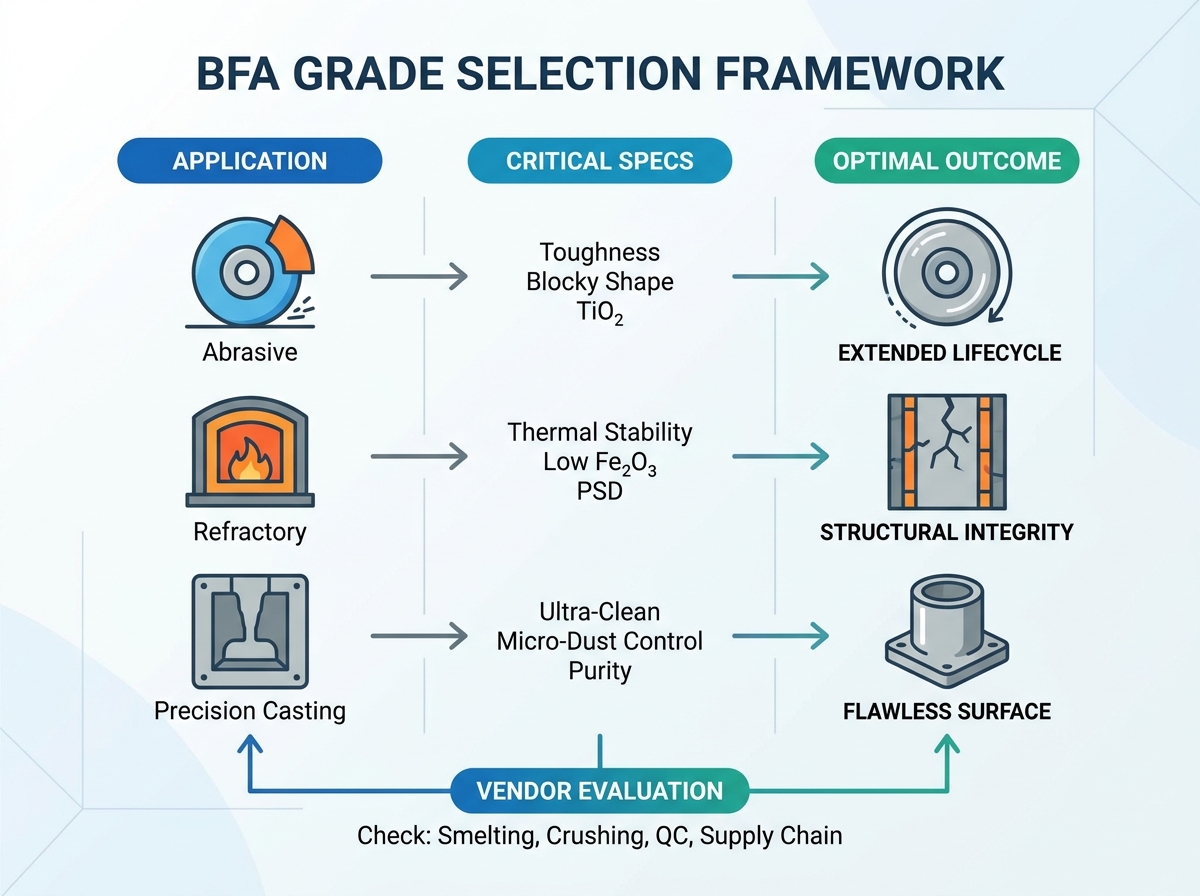
Manufacturers design abrasive-grade brown corundum for high-impact mechanical stress. It requires specific characteristics to perform effectively.
Criteria: This grade requires high toughness and a self-sharpening ability. It also demands specific blocky particle shapes. Blocky shapes resist premature shattering under heavy loads.
Outcomes: Proper selection extends the lifecycle of bonded abrasives, such as heavy-duty grinding wheels. It also improves coated abrasives. In sandblasting operations, it significantly reduces total abrasive consumption. The grains fracture evenly. This exposes new cutting edges instead of turning into useless dust.
Furnace environments subject materials to extreme thermal and chemical stress. refractory-grade brown alumina must withstand these harsh conditions without degrading.
Criteria: Buyers must prioritize thermal shock resistance. The material needs excellent volume stability at high temperatures. It also requires an exceptionally low magnetic iron content.
Outcomes: This precise chemical balance prevents cracking. It stops structural failure in furnace linings, dense castables, and kiln furniture. Low iron content prevents fluxing reactions. These reactions otherwise lower the melting point of the refractory structure.
Investment casting requires flawless ceramic shells. Foundries use precision casting alumina powder to achieve this high-tolerance finish.
Criteria: This application demands ultra-clean surfaces. It requires precise thermal expansion coefficients. Suppliers must exercise strict control over micro-dust limits.
Outcomes: Clean powder ensures flawless shell building in investment casting. It prevents unwanted metallurgical reactions between the ceramic mold and the molten metals. This eliminates costly surface defects on the final cast components.
Many buyers assume higher purity always equals better performance. This assumption frequently causes budget overruns. You must understand the balance between primary oxides and trace elements.
Alumina content dictates raw hardness. You need high-purity brown fused alumina (typically 95% to 97%+) for aggressive material removal. This baseline ensures the grain can cut through hard metals. However, chasing 99% purity is an unnecessary cost for high-impact applications. Material hitting 99% enters White Fused Alumina territory. White alumina is harder but significantly more brittle. It shatters instantly under heavy impact.
Titanium dioxide is not a contaminant. It is a critical performance enhancer. A controlled 1.5% to 3.0% TiO₂ range acts as a toughening agent. It integrates into the alpha-alumina crystal lattice during the electric arc smelting process. This addition allows the grain to absorb sudden impacts without shattering immediately. The TiO₂ content provides the necessary durability for rough grinding and high-pressure blasting.
While TiO₂ is beneficial, silica (SiO₂) and iron oxide (Fe₂O₃) present severe operational risks. You must strictly control them.
Silica (SiO₂): Excess silica forms a glass phase at high temperatures. This glass phase reduces the overall refractoriness of the material. It softens the matrix under thermal load.
Iron Oxide (Fe₂O₃): Magnetic iron poses catastrophic risks in refractory and precision casting applications. Free iron oxidizes rapidly. It causes rust spots on cast surfaces. In refractories, it melts at lower temperatures. This creates voids and compromises structural integrity.
Chemical composition means little if the physical particle size varies wildly. Proper grit sizing dictates finish quality and processing speed.
Global markets use different sizing standards. Europe follows FEPA. The United States uses ANSI. Japan relies on JIS. You must align your tooling specifications directly with the manufacturer's testing standard. A FEPA F-grit profile differs slightly from an ANSI profile. Mixing these standards leads to inconsistent abrasive performance. Always verify the sieving standard printed on the Certificate of Analysis.
Manufacturers divide BFA into two primary sizing categories. You must select the right category for your application.
Macro-grits (F8 to F220): We use these larger particles for heavy-duty cutting. They power aggressive surface blasting operations. They also serve as the structural aggregate in bulk refractories.
Micro-grits (F230 to F1200+): We use these fine powders for high-precision tasks. Applications include surface lapping and optical polishing. Foundries also use them for fine precision casting slurries.
Poor sieving creates significant operational hazards. Buying lower-tier grades often means accepting a wide particle size distribution (PSD). These batches contain excess fine dust. This dust chokes pneumatic blasting equipment. It blocks nozzles and disrupts media flow. In refractory applications, excess fines demand higher water ratios in castable mixes. Extra water evaporates during curing. This leaves behind microscopic voids. These voids severely weaken the refractory castable bonds.
Common Mistakes: Buyers often check only the nominal grit size (e.g., F60). They fail to check the standard deviation of the particle distribution. A wide distribution means you receive too many oversized rocks and too much useless dust.
Table 1: Macro vs. Micro Grit Application Matrix
Category | Grit Range (FEPA) | Primary Industrial Focus | Critical Performance Metric |
|---|---|---|---|
Coarse Macro | F8 - F36 | Heavy roughing, bulk refractory aggregate | Impact resistance, structural volume |
Medium Macro | F40 - F100 | Sandblasting, surface preparation | Self-sharpening, controlled breakdown |
Fine Macro | F120 - F220 | Coated abrasives, light deburring | Consistent surface finish |
Micro-Powders | F230 - F1200+ | Precision casting, optical lapping | Strict micro-dust control, high purity |
Shifting focus from product specifications to vendor reliability is crucial. An excellent spec sheet means nothing if the supplier cannot reproduce those results consistently. You must evaluate a brown fused alumina powder manufacturer using stringent criteria.
The core electric arc furnace technology dictates baseline quality. Traditional fixed furnaces cool the alumina melt slowly. This creates large, somewhat brittle crystal structures. Tilting furnaces pour the molten alumina into molds. This allows for faster, controlled cooling. Tilting furnaces generally produce BFA with higher toughness. They yield more uniform crystal structures. Ask your vendor which smelting method they employ.
After smelting, the manufacturer crushes the alumina blocks. The crushing method determines particle shape. Roll crushers produce sharp, splintery grains. These grains break easily. Look for manufacturers utilizing Barmac (VSI) crushing or ball milling. Barmac crushers throw the grains against each other. This rock-on-rock impact rounds off weak edges. It achieves the desired blocky particle shape necessary for long-lasting abrasive wheels.
Marketing brochures do not guarantee quality. You must audit their internal testing protocols.
Demand batch-to-batch Certificate of Analysis (CoA) data. Verify the actual sieve test results against the marketing spec sheets.
Check for routine magnetic separation passes. High-quality vendors run the material through powerful magnets multiple times.
Verify their washing capabilities. High-purity requirements demand water-washing or acid-washing. Acid washing removes residual surface iron and adhering dust completely.
Assess the vendor's raw material security. Do they have stable access to high-grade calcined bauxite? Determine their capacity to scale production volume. Many low-tier suppliers degrade particle size consistency when rushed to fulfill large metric-ton orders. A reliable vendor maintains strict PSD tolerances regardless of order volume.
Best Practices: Always request a virtual or physical facility tour. Look specifically for modern magnetic separators and dedicated sieving lines. Dedicated lines prevent cross-contamination between different grit sizes.
The global abrasive supply chain contains hidden traps. Procurement teams must maintain a skeptical, buyer-advocate mindset. Understanding what goes wrong prevents costly production downtime.
Price-driven procurement often leads to contaminated supplies. The hidden risk involves suppliers blending crushed scrap wheels or recycled blasting media into virgin BFA. This blended material contains residual resin bonds or glass vitrified bonds. It behaves unpredictably during high-temperature processing. Look for inconsistent coloring within the batch. A mix of pale and dark grains often indicates recycled blending. Erratic blasting performance or sudden drops in refractory strength also signal contamination.
Suppliers sometimes exploit vague terminology. You must clarify the difference between Fused Alumina and generic Aluminum Oxide. Generic aluminum oxide might simply refer to mildly calcined bauxite. This material remains soft and porous. "Fusion" implies the extreme electric arc furnace process. This intense melting process (exceeding 2000°C) creates the required, ultra-hard alpha-alumina crystal structure. Always specify "fused" in your purchase orders.
We cannot overstate the danger of magnetic iron. Some manufacturers skip the final magnetic separation step to save electricity and time. This presents catastrophic results in refractory applications. During furnace operation, this residual iron melts. It reacts with oxygen and expands. This expansion causes severe slag formation. It creates voids within the refractory brick. Ultimately, the entire furnace lining collapses prematurely.
Choosing the correct brown fused alumina requires discipline and technical awareness. Do not rely solely on lowest-price bidding. Instead, build a procurement framework based on verifiable data.
Shortlisting Logic: Base initial decisions on the specific application requirements. Differentiate between abrasive, refractory, or casting needs first. Next, narrow down your choices by necessary chemical tolerances. Pay strict attention to the Al₂O₃/TiO₂ ratio for optimal toughness. Finally, make your ultimate selection based on PSD consistency and blocky grain shape.
Next-Step Actions: Request a 25kg sample from your shortlisted suppliers. Demand the specific batch's Certificate of Analysis alongside the sample. Conduct a rigorous pilot run in a controlled factory environment. Verify dust levels and structural integrity before committing to multi-ton volumes.
A: White fused alumina features higher purity (typically 99%+ Al₂O₃). It is noticeably harder but significantly more brittle. It shatters easily upon impact. Brown fused alumina contains TiO₂. This addition makes the brown grain much tougher. It is far more suitable for heavy, repeated impact applications like sandblasting and rough grinding.
A: Start with a visual inspection. Look for color consistency. High-quality material shows a uniform deep brown or blue-brown hue. Next, conduct laboratory testing for true specific gravity. Finally, perform magnetic iron extraction tests using a strong neodymium magnet to ensure iron levels remain within safe operational limits.
A: Blocky grains lack weak, splintery edges. They hold significantly better within the resin or vitrified matrix of a grinding wheel. When subjected to grinding pressure, blocky grains fracture evenly rather than shattering entirely. This controlled breakdown offers a much longer wheel life compared to sharp, elongated grains.

 English