
- All
- Product Name
- Product Keyword
- Product Model
- Product Summary
- Product Description
- Multi Field Search

Views: 0 Author: Site Editor Publish Time: 2026-01-20 Origin: Site
The casting process is fundamental in a variety of industries, including aerospace, automotive, and medical manufacturing, where high precision and excellent quality are non-negotiable. In these sectors, the choice of molding material plays a critical role in determining the final quality of cast products. When compared to traditional silica sand, ceramic foundry sand stands out due to its enhanced characteristics, making it the ideal choice for precision casting. At Shanxi Taiyue Abrasive, we provide high-quality ceramic foundry sand that helps our customers achieve superior casting outcomes, reduce defects, and enhance operational efficiency.
Ceramic foundry sand is a premium casting material made from high-quality bauxite, a naturally occurring material rich in aluminum oxide. The manufacturing process of ceramic foundry sand involves several advanced techniques. First, bauxite is subjected to high-temperature calcination, followed by arc furnace melting and high-pressure gas blowing. These processes create spherical or nearly spherical grains with smooth surfaces. The sand is then carefully screened and cleaned using magnetic separation to remove impurities, ensuring that the product meets the highest standards for casting.
The primary differences between ceramic foundry sand and silica sand stem from their structural and thermal properties, which have a profound effect on the performance of casting materials.
Thermal Stability: Ceramic foundry sand exhibits exceptional thermal stability, allowing it to withstand the high temperatures encountered in precision casting without compromising its structural integrity. In contrast, silica sand tends to have a higher thermal expansion rate, which can lead to defects such as cracking during the cooling process. This makes ceramic foundry sand a more reliable material for high-temperature applications.
Surface Smoothness: The smooth, spherical grains of ceramic foundry sand allow for better packing in molds, resulting in a smoother and more uniform surface finish. Silica sand, with its angular grain shape, can lead to rougher surfaces and less consistent mold filling. The superior flowability of ceramic foundry sand enhances the mold’s ability to fill completely, leading to fewer surface imperfections.
The quality of a casting depends not only on the design and process but also heavily on the material used for the mold. In precision casting, where the demands for accuracy, surface finish, and overall integrity are much higher, selecting the appropriate sand is crucial. Ceramic foundry sand provides several advantages that directly impact the precision and quality of castings.
For industries that rely on high-precision components, such as aerospace and medical device manufacturing, achieving a flawless surface finish is paramount. Ceramic foundry sand helps achieve this by providing a smoother surface and more accurate mold filling. The spherical grains of ceramic sand ensure even distribution throughout the mold, leading to fewer defects such as roughness or uneven surfaces. This level of precision is particularly important when producing complex or intricate components that must meet stringent specifications.
Moreover, dimensional accuracy is critical in precision casting, as even the smallest discrepancies can affect the functionality and performance of the final product. The uniformity of ceramic foundry sand ensures that the mold maintains its shape and size during the casting process, leading to more precise, accurate castings.
The strength of the mold itself is another key factor that determines the overall quality of the casting. Ceramic foundry sand enhances mold strength due to its high structural integrity, which is further supported by the sand's low thermal expansion rate. This prevents mold deformation and cracking during the cooling phase. Silica sand, with its angular grains and higher thermal expansion, is more prone to mold weakness and can result in more frequent casting defects, including cracks and dimensional inaccuracies. Using ceramic foundry sand in the molding process improves the mold’s resistance to heat and stress, ensuring stronger and more durable molds that result in higher-quality castings.
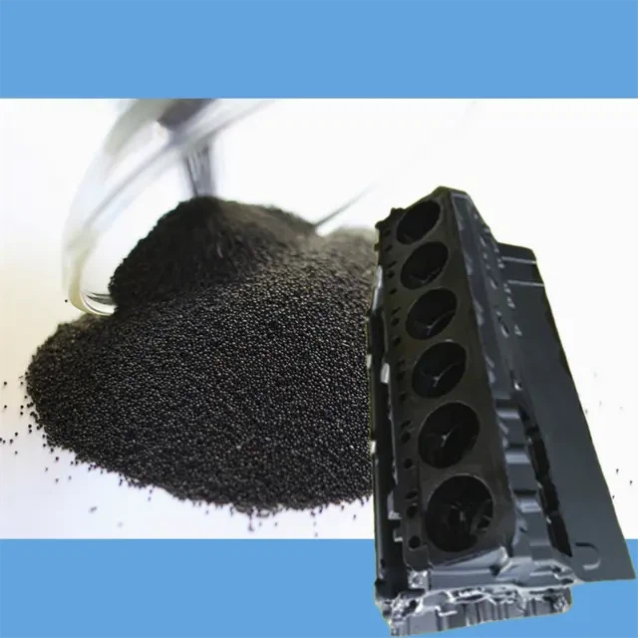
Understanding the key differences between ceramic foundry sand and silica sand is essential for making the right decision in casting applications. Below is a detailed comparison of both materials based on critical performance factors.
The ability of the molding material to withstand high temperatures without expanding or contracting excessively is crucial for achieving high-quality castings. Ceramic foundry sand has a significantly lower thermal expansion rate than silica sand. This means that during the cooling phase of the casting process, ceramic foundry sand will not expand as much, reducing the risk of cracks, deformations, or surface irregularities. Silica sand’s higher thermal expansion can lead to increased risk of defects and more frequent need for rework.
The flowability of the sand is another crucial factor in determining the success of the casting process. Ceramic foundry sand’s smooth, spherical grains allow it to flow easily into the mold, ensuring uniform filling and reducing the chance of air gaps or voids. This uniform flow contributes to a more consistent mold, which is essential for producing high-quality, precise castings. Silica sand, with its angular grains, does not flow as smoothly and often leads to uneven mold filling, resulting in defects like porosity or incomplete molds.
One of the advantages of ceramic foundry sand is its lower binder consumption. The smoothness and spherical shape of the grains mean that less binder is required to hold the sand particles together, leading to cost savings and a reduction in the amount of gas generated during the casting process. Silica sand, on the other hand, often requires more binder due to its irregular grain structure, which increases both material costs and gas generation. This higher gas generation can lead to casting defects such as porosity, which is more likely to occur with silica sand molds.
Property | Ceramic Foundry Sand | Silica Sand |
Refractoriness | High (>1800°C) | Moderate (~1600°C) |
Thermal Expansion | Very Low | Higher |
Shape | Spherical | Angular |
Binder Usage | Lower | Higher |
Defects in Casting | Fewer | More |
When examining real-world casting outcomes, the superior qualities of ceramic foundry sand are evident. Industries that require high precision, such as automotive and aerospace, are particularly well-suited to benefit from the unique properties of ceramic foundry sand.
One of the most noticeable benefits of using ceramic foundry sand is the reduction in porosity in the final castings. The spherical grains and superior packing properties of ceramic foundry sand help eliminate air pockets that could lead to weak spots in the casting. This results in stronger, more durable components, which are crucial in high-performance applications. Additionally, the reduced likelihood of cracks and surface imperfections means that the castings require less post-processing and rework, saving both time and money.
An automotive parts manufacturer recently transitioned to using ceramic foundry sand for casting engine components. As a result, the manufacturer observed a noticeable reduction in defects such as cracks, voids, and surface roughness. This improvement led to fewer rejected parts and reduced the time spent on finishing processes. The cost savings and improved production speed were significant, demonstrating the tangible benefits of ceramic foundry sand in casting operations.
The use of ceramic foundry sand can have a profound impact on your foundry’s operations, not only by improving casting quality but also by enhancing overall efficiency. Foundries that adopt ceramic foundry sand experience a reduction in material costs due to its recyclability and lower binder consumption. Moreover, the higher mold strength and better flowability of ceramic foundry sand lead to more efficient mold filling, reducing downtime and improving productivity.
By switching to ceramic foundry sand, foundries can reduce their material costs over time through its recyclability. Additionally, the reduced binder usage results in lower overall costs for the molding process. The higher flowability of ceramic foundry sand means fewer mold failures and less rework, further improving the cost-efficiency of the operation. The sustainability benefits of using ceramic foundry sand also contribute to a more eco-friendly casting process.
In summary, ceramic foundry sand offers a superior alternative to traditional silica sand, particularly for high-precision casting applications. Its lower thermal expansion, smoother surface finish, and better mold strength make it the ideal choice for industries that demand the highest standards of quality and precision. Furthermore, its recyclability and reduced binder consumption make it a cost-effective and sustainable solution for foundries looking to optimize their operations.
Shanxi Taiyue Abrasive’s ceramic foundry sand is the ideal material for foundries looking to improve the quality and efficiency of their casting processes. By choosing ceramic foundry sand, you can achieve better precision, lower defect rates, and reduced operational costs. For more information on how ceramic foundry sand can enhance your foundry’s performance, don’t hesitate to contact us today.
1. What makes ceramic foundry sand better than silica sand for precision castings?
Ceramic foundry sand offers smoother grains, better thermal stability, and fewer defects compared to silica sand, making it the ideal choice for high-precision castings.
2. Can ceramic foundry sand be recycled?
Yes, ceramic foundry sand is highly recyclable, allowing for significant cost savings and environmental benefits.
3. How does ceramic foundry sand improve mold strength?
The spherical grains of ceramic foundry sand create a more consistent and stronger mold that resists deformation and cracking during the casting process.
4. In which industries is ceramic foundry sand most commonly used?
Ceramic foundry sand is used in high-precision industries such as aerospace, automotive, and medical device manufacturing, where casting quality is of utmost importance.

 English


